The College Experience
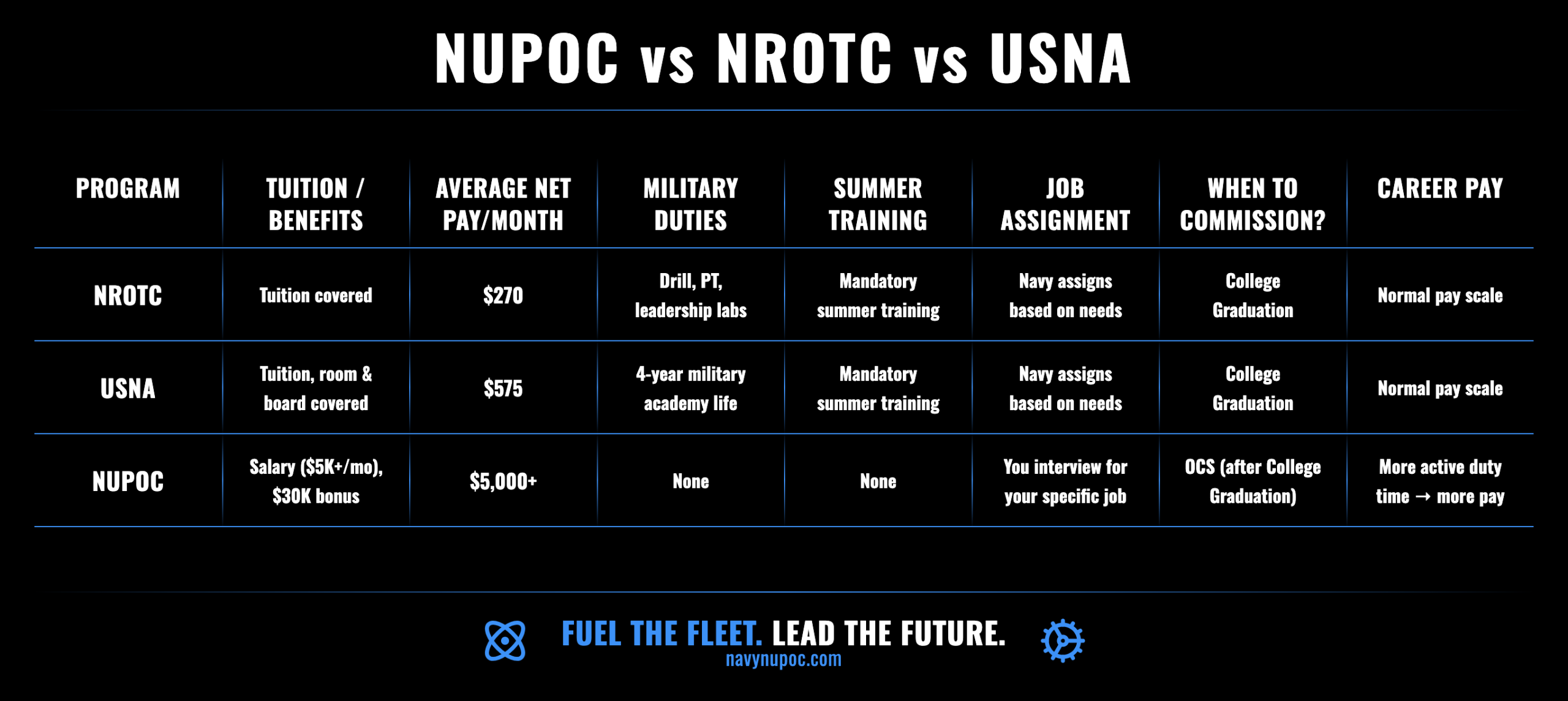
NUPOC: Normal Campus Life – NUPOC students remain full‑time college students. You attend the school of your choice, live in the dorms or off‑campus housing and pursue your major without wearing a uniform or participating in drills. There are no mandatory military classes, morning physical training or leadership labs. You focus on calculus, physics and your degree while staying physically fit. Outside of staying in shape, there are no military obligations until after graduation, which means you have the freedom to pursue internships, research or co‑op positions. Because NUPOC pays a full‑time salary while you are still in school, you do not need to juggle part‑time jobs or worry about covering rent or textbooks—the program’s pay and allowances cover your expenses so you can fully enjoy the college experience.
NROTC: Civilian Campus with Extra Commitments – NROTC midshipmen are enrolled at a civilian university and can choose any major, but they take a naval science class every semester and meet weekly for leadership laboratory. Twice a week they rise early for mandatory physical training, and they participate in a two‑hour professional development drill each week. Scholarship students also go to 3–4‑week summer cruises each year to learn about surface ships, aviation and submarines. Despite these obligations, midshipmen still enjoy a typical college social life and may join student clubs and athletics. Although the scholarship covers tuition or room and board and provides a modest stipend, most NROTC students must budget carefully for housing, meals and other costs—some still work part‑time or take out loans to make ends meet.
USNA: Immersed in the Military – Students at the U.S. Naval Academy live on campus in Annapolis. Midshipmen follow a regimented schedule with military training, mandatory athletics and limited off‑campus privileges. Plebe summer—the first summer—introduces you to naval life. The academy environment suits students seeking a fully immersive military education and the camaraderie of a service academy. Because the Navy pays for your tuition, housing and meals, you never need a part‑time job—your entire life is structured around academics, military training and athletics—and you earn a small stipend to cover personal expenses.
Financial & Career Benefits
During College
NUPOC – NUPOC does not pay your tuition. Instead, once you pass the Washington, D.C. interview you immediately begin earning a full‑time salary and signing bonus while still in school. Students in the NUPOC program typically earn between $4,500 and $6,000 per month (including housing and food allowances) and receive a up to $35,000 selection bonus paid as soon as you are accepted into the program. NUPOC collegiates are considered to be on active duty, which means they are entitled to all the benefits of that status, including full health care and access to base services. Actual financial benefits depend on where you live: higher cost‑of‑living areas provide higher housing allowances. This money goes directly to you, not to your university—you can use it to pay tuition, rent or food, or even invest for your future. Because you are already drawing a salary, NUPOC students don’t need to juggle part‑time jobs or student loans to cover living expenses.
NROTC – The NROTC scholarship covers full tuition and mandatory fees or room and board at a participating university. Midshipmen receive a textbook stipend of about $750 per year and a monthly allowance that starts at $250 for freshmen and increases to about $400 by senior year. Because the scholarship often only covers tuition and fees, many NROTC students must pay for their own room and board; the modest stipend may not fully cover rent and food, so some midshipmen still take on part‑time work or student loans. Tuition payments go directly to the school, not to the student, and NROTC time does not count toward pay longevity or GI Bill eligibility.
USNA – Naval Academy midshipmen attend on a full scholarship: the Navy pays 100% of tuition, room and board, and provides full medical and dental care. Midshipmen receive a monthly stipend (about $1,273 per month as of 2025) but take home only $100–$200 during the first year because the rest is withheld for uniforms, books and other fees. Because everything is covered, academy students don’t need part‑time jobs and won’t graduate with student debt. Like NROTC, however, time spent at the academy does not count toward pay longevity or GI Bill eligibility.
After Commissioning
Once you have earned your degree and taken the oath, the financial picture changes:
NUPOC – Because NUPOC time counts as active duty from the moment you’re accepted, you will reach higher pay brackets sooner than peers who commissioned through NROTC or USNA. The Department of Defense pay scale increases not only with rank but also with years of service, so your months of paid NUPOC time push you ahead on the chart. You continue to receive the same officer pay and allowances as your peers after commissioning, but you start at a higher longevity step. NUPOC time also accelerates eligibility for the Post‑9/11 GI Bill and for retirement credit, giving you the option to transfer education benefits to a spouse or children sooner. You accrue paid leave (vacation days) while still in school and continue to accrue it throughout your career.
NROTC & USNA – For NROTC midshipmen and USNA midshipmen, pay and benefits begin only after commissioning. Until then, your time as a student does not count toward pay longevity, retirement or GI Bill eligibility. After commissioning, you earn the same officer pay and allowances as your NUPOC peers, but you start at the bottom of the longevity ladder and will take longer to reach higher pay brackets. You accrue paid leave only after entering active service.
Training & Time Commitments
NUPOC – After graduation, NUPOC students attend either Officer Candidate School (OCS) or Officer Development School (ODS) depending on their chosen role. Submarine and surface warfare officers attend a 13‑week OCS, which is rigorous and designed to develop leadership skills and prepare candidates for line officer duties. Instructor and Naval Reactors engineer candidates attend a 5‑week ODS. Both courses are physically and mentally demanding, but ODS is shorter and tailored to staff officers. Once you complete OCS or ODS, you owe five years of active‑duty service as a nuclear officer. For nuclear paths, this means attending Nuclear Power School and Prototype training before reporting to your submarine or to Nuclear Reactors headquarters; other non‑nuclear jobs (like aviation) have different commitments—naval aviators, for example, incur an active‑duty commitment of about eleven years after commissioning.
NROTC – Midshipmen do not attend OCS or ODS. They commission directly at graduation and proceed to the next phase of officer training—for those entering the submarine force, this means Nuclear Power School and prototype training; surface warfare officers designated for nuclear billets delay their nuclear training until after their first ship tour. NROTC midshipmen fulfil officer training requirements through their on‑campus naval science classes, leadership labs and summer cruises. After commissioning, NROTC midshipmen who enter the nuclear community also owe five years of active duty, while other career fields carry different commitments (e.g., naval aviators typically owe about eleven years). Because of these ongoing commitments during college, they have less flexibility to hold internships or part‑time jobs compared with NUPOC students.
USNA – Naval Academy graduates also skip OCS/ODS. The academy itself combines academic coursework with military and physical training. After commissioning at graduation, they proceed to their assigned training pipeline (for example, Nuclear Power School for those entering the submarine force; nuclear surface officers attend after their first surface tour). Like NROTC, USNA graduates who pursue the nuclear path owe five years of active duty after commissioning, while other communities can carry longer or shorter commitments. The academy’s integrated military environment means your entire college experience is designed to develop you as a naval officer.
Job Assignment & Career Options
NUPOC – One of NUPOC’s distinctive features is that you interview for specific nuclear roles—submarine officer, surface warfare officer (nuclear), Naval Reactors engineer or instructor—and can decline an offer if it isn’t the right fit. Because NUPOC only covers nuclear jobs, you commit early to serving in the nuclear community. This focused path is ideal if you are excited about submarines, surface nuclear ships or teaching at Nuclear Power School. It is the only path to become a Power School or Prototype instructor or a Naval Reactors engineer.
NROTC – NROTC midshipmen rank their service preferences during their senior year, but final assignments are based on individual performance, qualifications, and the Navy’s needs. While many midshipmen receive their top choice, there is no guarantee. NROTC offers broader career options, including aviation, special warfare and intelligence, so it is a good choice if you are considering multiple Navy communities.
USNA – Like NROTC, academy midshipmen submit service preferences and are assigned based on order of merit and Navy requirements. They have access to the widest range of communities across the Navy and Marine Corps. If you excel academically, physically and militarily, you may have a strong chance of getting your first choice, but the ultimate decision rests with the Navy.
Putting It All Together: Why Choose NUPOC?
Choosing between NUPOC, NROTC and USNA depends on your goals, academic interests and desired college experience. NUPOC is particularly attractive if you:
Want a normal college experience – You can attend any accredited university, join clubs and sports and choose your major without military interruptions.
Prefer immediate financial independence – You receive a full‑time salary and signing bonus while still in school, and you accrue paid leave.
Are committed to nuclear service – NUPOC is the only path to become a Naval Reactors engineer or nuclear instructor. You also secure your specific job ahead of time and can decline if it’s not the right fit.
Value early retirement and GI Bill credit – Your time in NUPOC counts immediately toward service longevity and GI Bill eligibility.
Interview early and secure your future – Unlike NROTC or USNA, you don’t join NUPOC straight out of high school; you interview while you’re already in college. The upside is that you can apply very early—up to 42 months before completing your bachelor’s degree, or 54 months if you’re pursuing a combined bachelor’s–master’s program. This means you can lock in a salary and bonus before your peers have even started job hunting.
NROTC and USNA may be better fits if you want to enter a program straight out of high school or you’re interested in non‑nuclear communities (like aviation or special warfare) or prefer a more structured military environment. Both programs develop well‑rounded officers and provide world‑class training and leadership opportunities, but you will have less flexibility during college and less control over your initial job assignment.
Closing Thoughts
Whichever pathway you select—NUPOC, NROTC or the Naval Academy—you will raise your right hand and swear the same oath. All three produce leaders who will stand watch together aboard submarines, surface ships and at shore commands. The real differences are in the journey:
NUPOC is best for those who are certain they want to serve in the nuclear community and want the freedom of a traditional college experience. You’ll be paid like a professional while still in school, accrue service time early and secure a specific job well before graduation. Many officers from other commissioning sources later say they wish they’d known about NUPOC sooner.
NROTC offers a blend of college life and military training. Scholarship support can make an education affordable, and the program exposes you to various Navy communities through classes and cruises. It’s a good fit if you want to explore multiple career fields and appreciate structure but still value campus life.
USNA is the most immersive option. You join a corps of midshipmen and live, study and train under the watchful eye of the Navy for four years. Everything is paid for and your entire day is planned, which can appeal to students seeking more military-style camaraderie, structure, tradition, and a service‑academy experience.
No matter what you choose, you will ultimately wear the same uniform and lead sailors with the same commitment to honor, courage and commitment. Weigh the freedom and financial independence of NUPOC against the structure and broader career exploration of NROTC and USNA. Talk with recruiters, reach out to alumni and make the decision that sets you up for both academic success and a fulfilling career in the U.S. Navy.